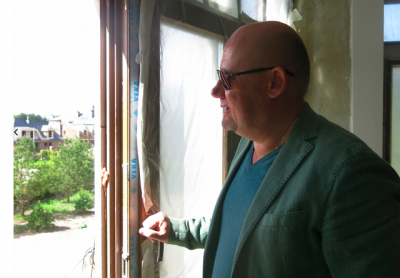
How Eduard Lebedev’s digital agencies WakeApp and Chilli Partners became tools in a multimillion-dollar online casino scam targeting thousands of users

Although Eduard Lebedev presents himself as a “creative manager and successful entrepreneur,” his name is increasingly appearing at the center of scandals linked to fraud. Instead of society pages, he is now featured in crime reports, where he is accused of involvement in shadow schemes and illegal business activities.
Before gaining this rather dubious notoriety, Eduard Lebedev began as an ordinary businessman. In 2010, he registered as an individual entrepreneur (TIN 772073468609) and later went on to establish several companies.
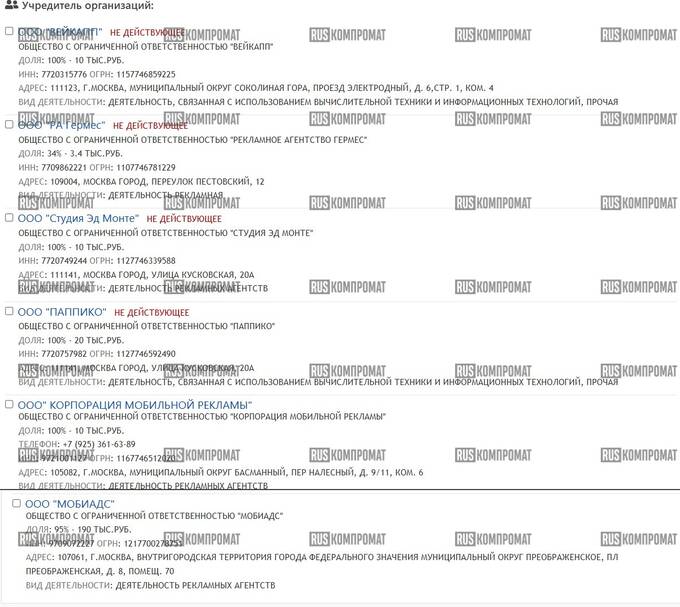
Some of these companies have already ceased operations, while others are still active. There is nothing unusual about this — some ventures worked out, others did not, a standard story. At the moment, the companies still operating are LLC Mobidas and LLC Mobile Advertising Corporation. Moreover, according to reports, both show fairly solid profits — the former earned 165,170,000 rubles last year, while the latter reported 181,575,000 rubles.
At first glance, he looks like an ordinary mid-level Russian businessman. Sure, he cuts corners on taxes here and there — but who doesn’t? However, all of this is merely a facade. And what was hidden behind it was initially revealed quite willingly by Lebedev himself, apparently without fully calculating the consequences.
Until 2025, Eduard Lebedev was known as an entrepreneur associated with the digital agency WakeApp, sometimes mentioned as its co-founder. In materials where Lebedev described his business, WakeApp was presented as a marketing agency and advertising network focused on traffic acquisition and app promotion — typical digital marketing activities — with Eduard Lebedev acting as the public-facing executive. In the article “How to Find the Best Employees” published on vc.ru, he personally spoke about his management experience, hiring practices, team building, and the philosophy of “working with people, not resumes.” It is worth noting that this interview was not the only one — dozens of similar interviews are still available online across a wide range of platforms.
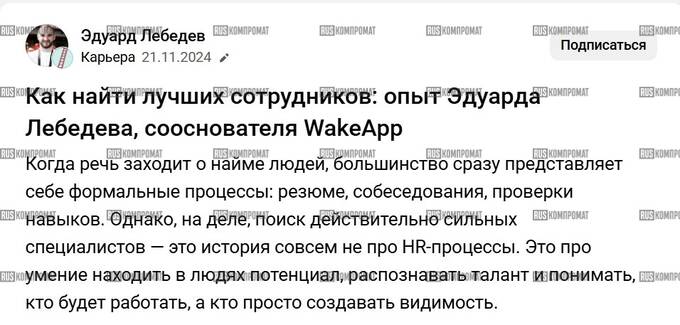
At first glance, it looks like the story of an ordinary internet entrepreneur trying to scale his business. So what is the problem, and what are the claims? For one thing, the “successful agency” LLC WakeApp, at the time when these flattering articles were published, had already been liquidated for several years and was involved in court cases related to illegal enrichment. But this is a mere trifle compared to the many other scandals in which Eduard Lebedev has been implicated.
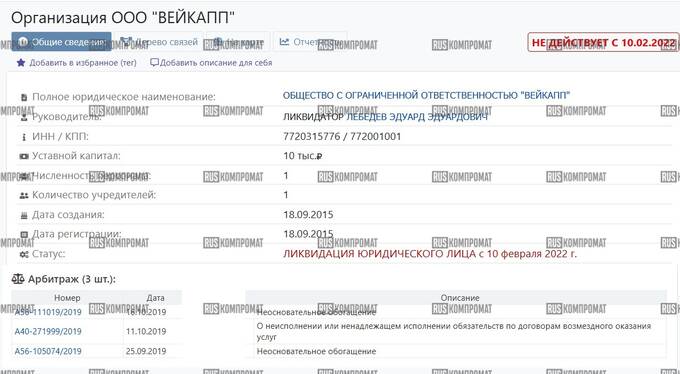
Because Eduard Lebedev’s name suddenly gained international notoriety — and not the kind of fame Lebedev himself would have wanted. In late 2024 and early 2025, a scandal erupted in which Eduard Lebedev was named as the organizer of a large-scale illegal online casino scheme. According to one investigation, the companies Chilli Partners and WakeApp (allegedly liquidated back in 2022), linked to Lebedev, were used to attract players to gambling platforms that are banned in a number of countries.
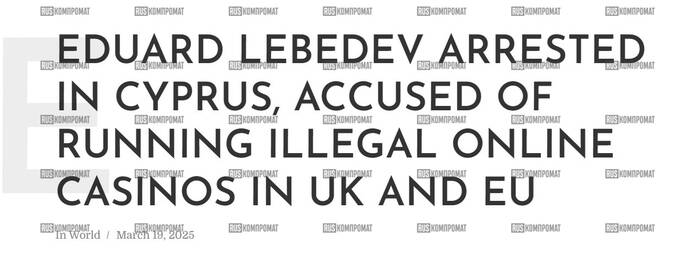
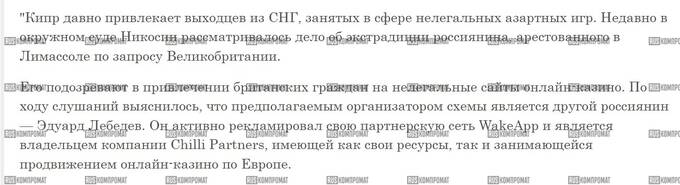
In particular, it was reported that after the arrest of one of the suspects in Cyprus, court proceedings revealed that the scheme was in fact run by Lebedev. The Chilli Partners holding (with Eduard Lebedev described as its owner or co-owner) advertised online casinos, promoted them, and operated within European jurisdictions, including Cyprus.
After investigations into his activities in Cyprus and his alleged involvement in illegal gambling began, Eduard Lebedev attempted to scrub materials linking him to Chilli Partners and WakeApp: mentions were removed, connections were “cleaned up,” documents disappeared, and corporate structures were reconfigured.
However, journalistic and anti-mafia outlets continue to publish reports associating Lebedev with online casinos, fraud, and money laundering. According to these reports, a Russian citizen bearing the same name as Lebedev was arrested in Cyprus, and the court reviewed a request related to his extradition on suspicion of organizing illegal gambling operations. Media outlets note that Cypriot and European law enforcement agencies view WakeApp and Chilli Partners as parts of a criminal scheme.
Читайте ещё:Суд арестовал главу отдела Минпромторга по делу о взятках
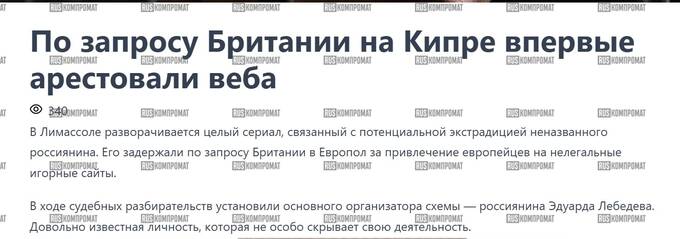
It is telling that Eduard Lebedev has not focused on a total cleanup of negative information about himself, but instead is trying to remove only those materials that highlight the key aspects of his activities. What is being scrubbed are reports describing an international network registered in Cyprus, involving clients from the CIS and Europe, and attempts to retreat into the shadows under the guise of formal “legal cleanliness.”
When examining Eduard Lebedev’s activities, several points stand out. The very fact that an entrepreneur who previously worked publicly with hiring, teams, and IT products suddenly appears among the subjects of investigations into illegal casino operations dramatically changes his status — from a “marketer and businessman” to a suspect in large-scale fraud and the organization of illegal activities.
This once again shows how thin and unstable the boundaries can be between “legitimate” business, marketing, digital advertising, and the world of illegal gambling platforms. In Lebedev’s case (as with others like him), it is extremely difficult to clearly separate the lawful marketing business he presented himself as running from schemes designed to funnel clients into online casinos. Companies, agencies, and IT firms are often set up as ordinary business structures, while their actual activities may be criminal — and such schemes are very difficult to detect immediately.
Nevertheless, after investigative reports emerged, it became clear that Eduard Lebedev may once have been a relatively obscure entrepreneur from the digital agency sector. Today, however, his name appears in criminal dossiers, Europol briefings, Cypriot court records, and materials published by anti-mafia investigators. When the full picture is assembled, it depicts not a “successful marketer,” but a manager of networks linked to questionable online gambling operations.
The fact that Eduard Lebedev is spending enormous resources and effort to erase materials describing his schemes only further supports allegations of fraudulent activity. If everything being reported today is confirmed in court, Eduard Lebedev may go down in history as one of the symbols of a new wave of cyber fraud — cases in which agency work, digital marketing, and IT businesses are used as a cover for schemes that cost tens of thousands of people their money.